
 |
 |
 |
 |
 |
 |
 |
TransPAC
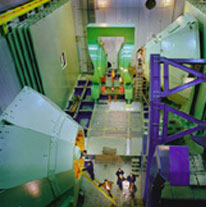 |
Pioneering High-Energy Nuclear Interaction Experiment (PHENIX) Nearly 1,000 physicists from around the world are cooperating to build several experiments at Brookhaven National Laboratory’s Relativistic Heavy Ion Collider (RHIC), to capture and analyze the results of RHIC collisions. PHENIX and STAR are the large experiments, or detectors. The PHENIX detector will look for many different particles emerging from RHIC collisions, including photons, electrons, muons and quark-containing particles called hadrons. To do so, it will use large steel magnets that surround the area where RHIC collisions will take place. Photons (particles of light) and leptons (electrons and muons) are not affected by the strong force, which binds quarks and gluons together into hadrons. Because they can emerge from the interior of a RHIC collision unchanged, photons and leptons can carry information about processes or actions within the collision. By focusing on them, PHENIX will be able to “gaze” inside the collision, and gain insight into its internal structure. PHENIX has over 450 members from 45 institutions in 10 countries. The Center for Nuclear Study (CNS), University of Tokyo maintains the International Collaboration in Experimental Research in High Energy Heavy Ion Collisions web server, and has collaborated with various U.S. and Japanese institutions to construct PHENIX’s RICH (Ring Image Cherenkov Counter) subsystem and RICH FEE (Front End Electronics). The PHENIX Computing Center in Japan (CC-J) at RIKEN Wako, will serve as the principal site of computing for PHENIX simulations, a regional PHENIX Asian computing center, and a center for the analysis of RHIC spin physics. The planned computing capacity will be sufficient to meet the bulk of the simulation needs of PHENIX. The planned robotic storage capability will permit efficient micro-DST production as a regional computing center. By providing a vital source of regional computing, the CC-J will also encourage collaborators from China, Korea, India and Japan to be actively involved in analysis of PHENIX physics data. |
| Contact |
Sam Aronson Brookhaven National Laboratory USA aronsons@bnl.gov Hideki Hamagaki Center for Nuclear Study, The University of Tokyo (CNS) USA hughes@cps.msu.edu James Tiedje Center for Microbial Ecology Michigan State University USA hamagaki@cns.s.u-tokyo.ac.jp |
| Collaborators |
Brookhaven National Laboratory USA The University of Tokyo, RIKEN Japan |
www.rhic.bnl.gov
phenix.cns.s.u-tokyo.ac.jp
| web @ startap.net |  |