
 |
 |
 |
 |
 |
 |
 |
RENATER2
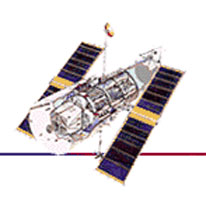 |
Hubble Space Telescope The Hubble Space Telescope (HST) is a cooperative program of the European Space Agency (ESA) and the National Aeronautics and Space Administration (NASA) to operate a long-lived space-based observatory for the benefit of the international astronomical community. HST is an observatory first dreamt of in the 1940s, designed and built in the 1970s and 80s, and operational only in the 1990s. Since its preliminary inception, HST was designed to be a different type of mission for NASA--a long-term space-based observatory. To accomplish this goal and protect the spacecraft against instrument and equipment failures, NASA had always planned on regular servicing missions. Hubble has special grapple fixtures, 76 handholds, and stabilized in all three axes. HST is a 2.4-meter reflecting telescope that was deployed in low-Earth orbit (600 kilometers) by the crew of the space shuttle Discovery (STS-31) on April 25, 1990. HST’s current complement of science instruments include three cameras, two spectrographs, and fine guidance sensors (primarily used for astrometric observations). Because of HST’s location above the Earth’s atmosphere, these science instruments can produce high-resolution images of astronomical objects. Ground-based telescopes can seldom provide resolution better than 1.0 arc-seconds, except momentarily under the very best observing conditions. HST’s resolution is about 10 times better, or 0.1 arc-seconds. Responsibility for conducting and coordinating the science operations of the HST rests with the Space Telescope Science Institute (STScI) on the Johns Hopkins University Homewood Campus in Baltimore, Maryland. |
| Collaborators |
Space Telescope Science Institute (STScI) The Johns Hopkins University, University of Washington, University of California at Berkeley, University of Hawaii, Vassar College, Ohio State University, University of Arizona, The University of Texas at Austin USA Sterrewacht, Leiden University The Netherlands CEA-CEN Saclay France Osservatorio Astronomico di Padova Italy |
www.stsci.edu
| web @ startap.net |  |