
 |
 |
 |
 |
 |
 |
 |
TransPAC
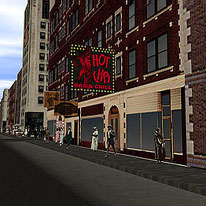 |
Cultural Heritage in Virtual Reality Using Cultural Heritage as an application driver, the goal of the Networked Virtual Environments Collaborative Trans-Oceanic Research (N*VECTOR) project is to link the University of Illinois’ CAVE and University of Tokyo’s CABIN, both room-sized virtual reality devices (VR), to better understand the requirements of multiple media flows among sophisticated VR displays over great distances. The two universities are studying collaborative problem solving over advanced networks using Nippon Telegraph and Telephone Corporation’s (NTT) MediaCruising Standard Protocol (MCSP), a prototype Quality of Service protocol optimized for streaming media and bulk data transfer over next generation networks. Applications using MCSP are implemented over GEMnet, NTT’s global research network. One such application is the Tele-Collaborative Virtual Harlem, which was developed to supplement African American Literature courses taught in US universities, and focuses on the Harlem Renaissance that began in the 1920’s. A virtual environment allows networked students around the world to meet and become immersed in an interactive literature course. Students can navigate and investigate the environment, and hear a sampling of the music written and popularized during the period. Earlier application studies using MCSP included high performance videoconferencing using MPEG-2, and remotely controlled Super High Definition image capture, transmission, and display. |
| Contact |
Jason Leigh Electronic Visualization Lab (EVL) at the University of Illinois at Chicago USA spiff@evl.uic.edu |
| Collaborators |
University of Illinois at Chicago USA The University of Tokyo Japan |
www.evl.uic.edu
| web @ startap.net |  |